
Displaying items by tag: Alexandra Silber
A Quietly Ravishing Night: Marriott’s A Little Night Music
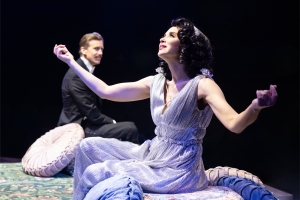
Marriott Theatre’s in‑the‑round intimacy turns A Little Night Music - which premiered on Broadway in 1973 and later became a 1977 film - into a quietly seductive swirl of glances, secrets, and second chances, the kind of production where the waltz feels like its own character. Under the soft glow of perpetual twilight, Sondheim’s lovers and liars circle one another with equal parts longing and restraint, and the space itself heightens every stolen look and half‑spoken truth. It’s a show built on emotional undercurrents, and Marriott’s staging lets those currents ripple right through the audience.
Stephen Sondheim’s A Little Night Music unfolds like a slow-turning dance that keeps tightening its circle, drawing its characters closer to the truths they’ve been avoiding. Set in a turn‑of‑the‑century Sweden where manners are crisp but desires run hot, the story follows lawyer Fredrik Egerman, a man trying to convince himself he’s content. He’s recently married Anne, a porcelain‑delicate young bride who’s still clinging to her innocence, while his son Henrik broods in the corner, nursing both a cello and an unspoken crush.
Everything tilts when Fredrik reconnects with Desiree Armfeldt, the actress he once loved and never quite got over. Desiree, ever the pragmatist, is juggling her own complications - namely Count Carl‑Magnus Malcolm, a swaggering dragoon whose jealousy burns hotter than his intellect. When Desiree attempts to untangle her romantic knots, she invites everyone to her mother’s country estate for a “quiet weekend,” which of course becomes anything but.
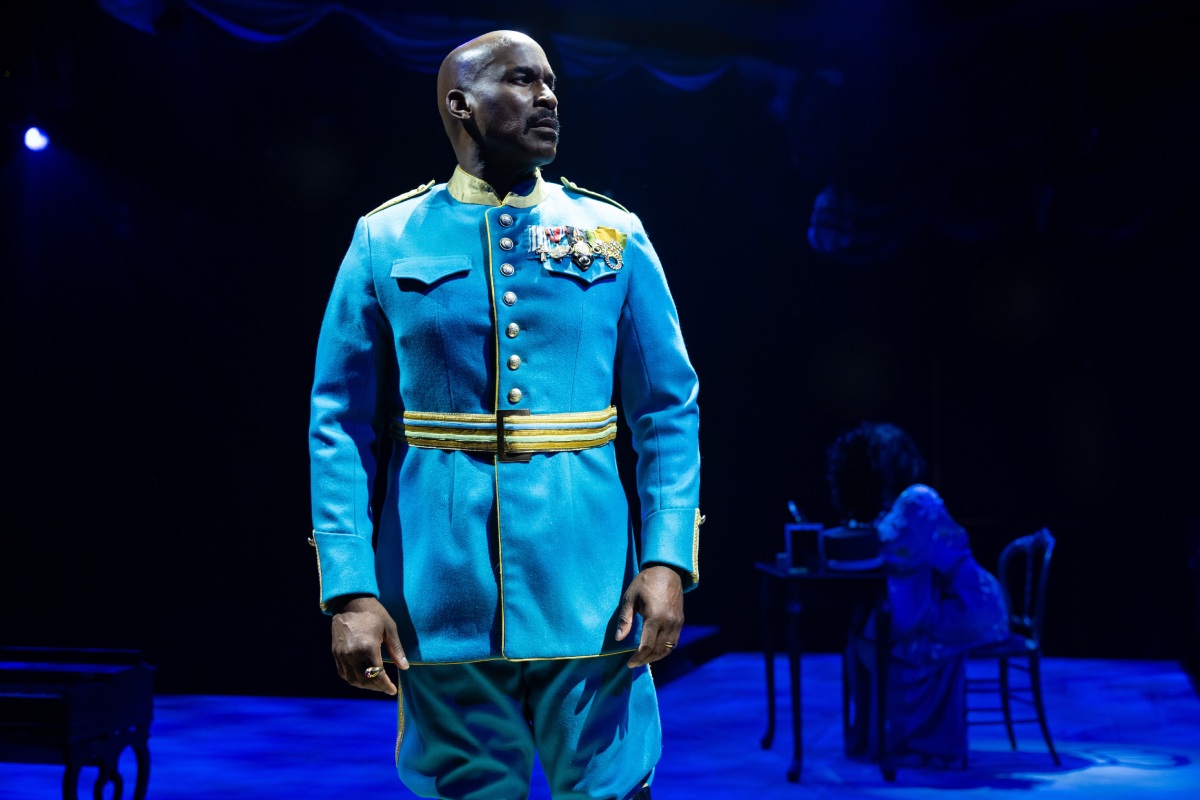
Alan H. Green in Marriott Theatre's A Little Night Music.
What follows is a weekend of mismatched couples, misread signals, and emotional truths finally spoken aloud. Under the glow of the perpetual Nordic twilight, partners shift, illusions crack, and the characters discover that love - in all its foolishness and ache - is rarely tidy but often exactly what they need. By the time the final waltz resolves, hearts have realigned, old wounds have softened, and the night has delivered its promised wisdom.
Sondheim’s score remains the production’s quiet spellbinder - a latticework of turning phrases, reprises, and melodic ironies that reveal as much about the characters as the book does. Songs like “Now,” “Soon,” and “Later” braid together with clockwork precision, exposing the emotional stalemates everyone is too polite to name, while “A Weekend in the Country” bursts with layered wit and rising chaos. And when the music finally slows into the aching simplicity of “Send in the Clowns,” the entire evening seems to exhale. Marriott’s staging lets these songs land not as showpieces but as confessions, each one circling closer to the truths the characters have been dancing around all night.
Under Nick Bowling’s beautifully calibrated direction, A Little Night Music moves with a clarity, elegance, and emotional intelligence that allows every waltz, glance, and confession to land with quiet precision.
Marriott’s production finds its center of gravity in Alexandra Silber, whose Desirée Armfeldt glows with the practiced sparkle of an actress slightly past her prime who knows exactly how she’s perceived and used by the married men who adore her - and the bruised vulnerability of someone who’s finally tired of the performance. Silber calibrates every beat with care: the sly asides, the brittle composure, the ache that flickers just beneath the surface. When she reaches “Send in the Clowns,” it doesn’t arrive as a grand gesture but as something far more intimate - a truth about the “bread crumbing” type of love she’s accepted as a traveling working actress that she’s been circling and battling for years. Opposite her, Andrew Samonsky gives Fredrik Egerman a beautifully worn‑in charm, the kind of man who hides his longing behind polite smiles and a touch of self‑mockery. His Fredrik isn’t a fool; he’s a man quietly unraveling, caught between the mature love he’s built and the young carefree one he still imagines he can achieve with his much younger bride. Samonsky’s performance is both sensual and frustratingly narcissistic. One example of this is when Fredrik apologizes to Desiree - as he leaves her heartbroken yet again - for confessing the tempting truth that her very presence is his safe haven… even though he has no intention of ever being saved by her.
I absolutely adored every delicate moment between lovers, friends, and husbands and wives in this gracefully performed piece, which reveals how men and women are still, even now, navigating the ever‑shifting moods of the partners in their lives in order to sustain lasting relationships.
Alan H. Green makes a vivid impression as Count Carl‑Magnus Malcolm, swaggering through the role with puffed‑up bravado and razor‑sharp comic instinct. Veronica Garza matches him effortlessly as Charlotte, her barbed wit and impeccable comedic timing turning bitterness into something unexpectedly funny and deeply human. Addie Morales gives Anne a shimmering, anxious innocence that feels grounded, while Eldon Warner‑Soriano lets Henrik’s turmoil simmer until it finally breaks open into something raw and affecting.
The singing voices of every single member of this talented and attractive cast are of true opera quality, and paired with the astoundingly modern, lyrical poetry of Sondheim’s evergreen script, I found myself leaning in to catch every word from their lips like a bee sipping nectar from flowers. Across the board, the vocals are rich, expressive, and beautifully attuned to the intricacies of Sondheim’s score.
From there, Carmen Roman anchors the evening with a magnetic, unhurried authority as Madame Armfeldt, delivering Sondheim’s sharpest observations with the cool precision of someone who has cataloged every shade of heartbreak and delicious, luxurious romance from men of great standing throughout her long life. She brings down the house with superbly dry one‑liners like, “Don’t serve them the best champagne - I’m saving that for my funeral!”
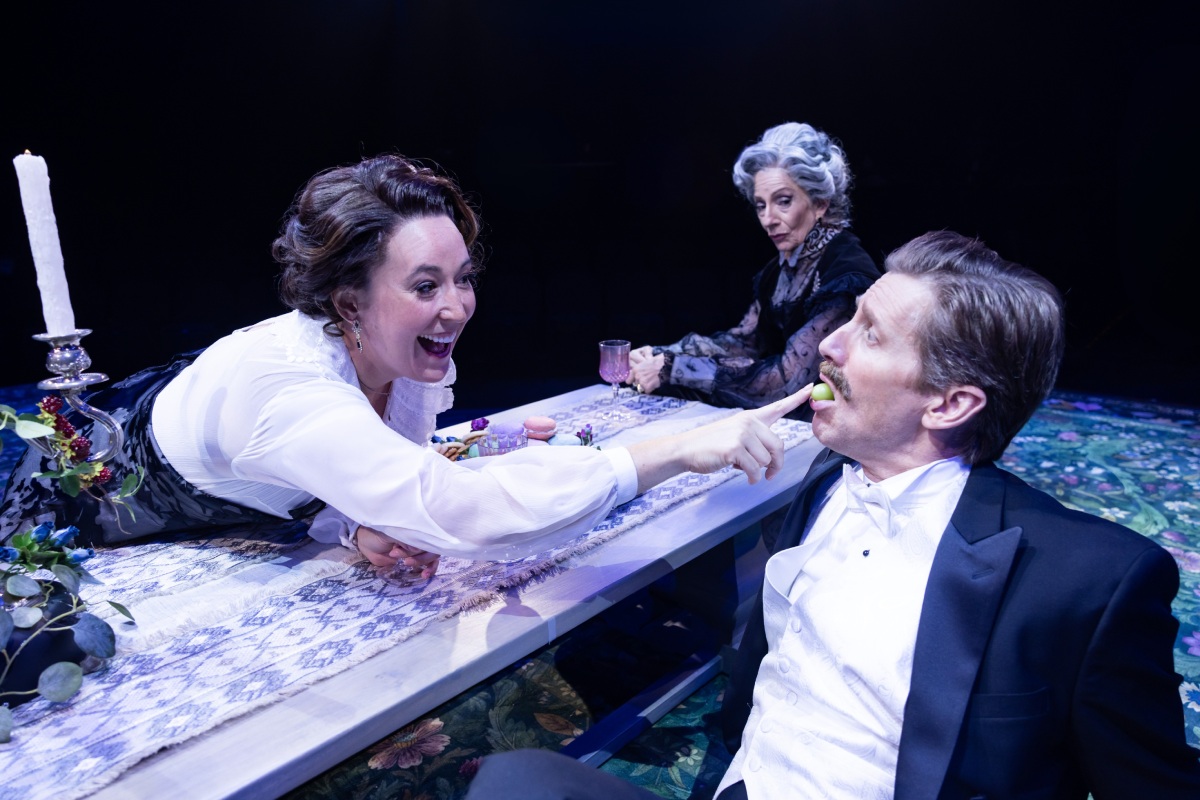
Veronica Garza, Andrew Samonsky and Carmen Roman (rear) in A Little Night Music at Marriott Theatre. Photos by Justin Barbin.
Madison Uphoff brings Petra a bold, earthy vitality - a reminder that desire belongs to everyone, not just the elegantly miserable. Together, this ensemble moves through Sondheim’s bittersweet waltz with nuance, confidence, and a clear understanding of the emotional architecture beneath the score.
Scenic Designer Regina García shapes the evening with a clean, elegant visual world that proves how little is needed to conjure an entire emotional landscape. The stage remains mostly bare - a chaise lounge here, a writing desk there - yet the details she chooses carry real poetic weight: a graceful two‑person swing drifting down from the rafters like a shared memory, a balmy moon casting its soft glow across the space, and strands of hanging lights and flowing ribbon that give the in‑the‑round theatre the feeling of a summer night suspended in time.
Associate Choreographer Katie Johannigman threads movement through this environment with a light, intuitive touch, while under Brad Haak’s baton, Sondheim’s score unfurls with clarity and warmth. Sally Dolembo’s costumes superbly wrap the production in period elegance. Dolembo’s designs resemble modern ballet costumes and express the unique sensuality and sexuality of both the male and female characters in a most tasteful and expressive way that makes your eye want to follow their every move especially the graceful way they make love to one another. The delicate, mostly pastel costumes emote a subtle erotic beauty without overwhelming each character’s emotional and comedic shifts as the night deepens and the whirl tightens its hold.
Marriott Theatre’s A Little Night Music unfolds on the perfectly intimate size of their theatre in the round stage, and the production’s emotional reach is anything but small. What emerges over the course of the evening is a circling dance of sensual longing, unrequited love and unexpected grace - a reminder of how Sondheim’s work can pierce straight through the heart when handled with this level of care. By the time the final notes fade and the lovers step back into the soft glow of twilight, the production has delivered something quietly luminous: a story about desire and forgiveness told with wit, tenderness, and a deep understanding of the ways men and women walk the tightrope of love and pride, playing love like a game of egos until they realize true love is the one thing they truly cannot live without.
Highly recommended.
For tickets and/pr more show information, click here.
Stephen Sondheim's A Little Night Music - Marriott Theatre - Through August 9th

Marriott Theatre, Chicagoland's longest-running musical theatre, presents A Little Night Music, a Tony Award-winning musical from Stephen Sondheim and Hugh Wheeler that explores the lush, witty, and poignant complexities of love, longing, and second chances. Directed by Nick Bowling (Marriott Theatre: The Sound of Music, Ragtime, Man of La Mancha; and recipient of eight Jeff Awards for outstanding direction), choreographed by Associate Artistic Director Katie Johannigman (Marriott Theatre: Titanic, The Magic School Bus), with music direction by Jeff Award winner Ryan T. Nelson, A Little Night Music previews June 17, and will run through August 9.
Love makes fools of us all. The Best Musical Tony Award-winning A Little Night Music is a sumptuous, sexy, laugh-out-loud masterpiece that will leave you thoroughly enchanted. Set in 1900 Sweden, A Little Night Music explores the tangled web of affairs centered around actress Desirée Armfeldt, and the men who love her. Amid a flurry of jealousy and suspicion, infinite possibilities of new romances and second chances bring endless surprises. Full of hilariously witty and heartbreakingly moving moments of adoration, regret and desire, this dramatic musical celebration of love features some of Stephen Sondheim's most popular songs, including the haunting "Send in the Clowns."
"When I first encountered A Little Night Music as a musical theater student in the late 1980s, I surprisingly connected deeply to a story about middle-aged lovers in turn-of-the-century Sweden," said Director Nick Bowling. "For many artists and audiences alike, this jewel-box musical remains one of the theatre's greatest achievements—not only among Sondheim's works, but of the entire musical theater canon. It is a privilege to return to this story which has captivated me for almost 40 years, and to do so alongside the extraordinary Alexandra Silber and Andrew Samonsky, leading an incredible cast and design team."
A Little Night Music stars Alexandra Silber as "Desirée Armfeldt" (Broadway: Fiddler on the Roof, Master Class; Marriott Theatre: The Music Man), Andrew Samonsky as "Fredrik Egerman" (Broadway: South Pacific, The Mystery of Edwin Drood, Scandalous; North American Tour: Parade, Come from Away), Carmen Roman as "Madame Armfeldt" (National Tour: Angels in America; Rivendell: Scientific Method; Old Globe: The Garden of Anuncia; Goodman: Brutality of Fact; Steppenwolf: Side Man; Northlight: Master Class), and Alan H Green as "Count Carl-Magnus Malcolm" (Broadway: Charlie and the Chocolate Factory, School of Rock, Sister Act, Play On!); with Veronica Garza as "Countess Charlotte Malcolm," Addie Morales as "Anne Egerman," Eldon Warner-Soriano as "Henrik Egerman," and Madison Uphoff as "Petra," alongside Joel Gelman, Kelli Harrington, Jake DiMaggio Lopez, Michael Earvin Martin, Victoria Okafor, Olivia O'Sullivan, Colette Todd, with understudies Annabel Finch, Brian Hupp, Adelina Marinello, Albert Sterner, and Ava Lane Stovall.
The artistic team features Associate Choreographer Joshua Kenneth Allen Johnson, Assistant Director Myesha-Tiara, Scenic Designer Regina García, Costume Designer Sally Dolembo, Wig, Hair & Makeup Designer Miguel A. Armstrong, Lighting Designer Jesse Klug, Sound Designer Michael Daly, Props Designer Amy Peter, Conductor Brad Haak, Intimacy Coordinator Kristina Fluty, and Stage Manager Katrina Herrmann.
A Little Night Music is scheduled to run Wednesdays at 1 p.m. and 7:00 p.m., Thursdays at 7:00 p.m., Fridays at 7:30 p.m., Saturdays at 4 p.m. and 8 p.m., and Sundays at 1 p.m. and 5 p.m., with select Thursday 1:00 p.m. shows. Call for dinner-theatre, student, senior, and military discounts. Free parking is available at all performances. To reserve tickets or become a Marriott Theatre subscriber, please call the Marriott Theatre Box Office at 847.634.0200 or go to www.tickets.marriotttheatre.com. To make a restaurant reservation or to purchase a Dinner Theatre Package, please call 847.634.0100 or visit www.marriotttheatre.com.
Murder, Deception, and Mid-Century Glamour at Drury Lane Theatre

Something wicked is winding its way through the velvet curtains of Drury Lane Theatre—and it reeks of roses, red wine, and murder. Dial M for Murder, the classic thriller originally crafted by Frederick Knott in 1952 and immortalized on screen by Alfred Hitchcock in 1954, returns to the stage with a razor-sharp adaptation by Jeffrey Hatcher that’s as stylish as it is sinister.
Set against the moody backdrop of 1950s London, the production invites us into the polished yet precarious world of Margot (Amanada Drinkall) and Tony Wendice (Erik Hellman) - a couple whose marriage gleams with charm but conceals a darker undercurrent. Beneath the tailored suits and cocktail-hour smiles lies a web of betrayal, manipulation, and a meticulously plotted murder that threatens to unravel with every twist of the telephone cord.
Hatcher’s adaptation breathes fresh life into the suspense, tightening the dialogue and sharpening the stakes while preserving the noir elegance of the original. The result is a theatrical experience that feels both vintage and vital - a slow burn that simmers into a full-blown psychological inferno.
Tony Wendice, a former tennis star turned calculating husband, discovers his wife Margot’s affair with mystery writer Maxine Hadley (Alexandra Silber). Rather than confront her, he plots her murder with chilling precision, believing one perfect move will reclaim his unraveling life.
But perfection proves elusive.
When the plan collapses, the story spirals into a maze of blackmail, disloyalty, and psychological warfare. Margot becomes both pawn and player, navigating a world where loyalties shift, truths blur, and every silence speaks volumes.
This isn’t just a thriller—it’s a taut exploration of control, vulnerability, and the artful menace of manipulation.

Alexandra Silber, Amanda Drinkall, Erik Hellman in Drury Lane Theatre's Dial M for Murder.
The players are sensational in the dialogue heavy, quick witted, edge-of-your-seat mystery thriller. Erick Hellman delivers a diabolical and shrewd Tony, Amanda Drinkall is delightful as Margot and Alexandra Silber is a true force as Maxine. Johnathan Weir is also tremendous as sleuthing Inspector Hubbard while Ian Paul Custer is perfectly cast as the Tony’s patsy, Captain Lesgate.
Wonderfully directed by Adam Immerwahr in his Drury Lane debut, this production of Dial M for Murder masterfully marries vintage intrigue with a brisk, modern rhythm. It’s not just a revival - it’s a reinvention – and Drury Lane Theatre is the perfect venue to stage this mystery thriller. The bones of Frederick Knott’s original mystery remain intact, but the pacing has been sharpened, the humor dialed up, and the twists recalibrated for a contemporary audience.
Visually, the production luxuriates in noir-inspired elegance, its seductive precision shaped by a powerhouse design team: Paige Hathaway’s scenic work evokes shadow and intrigue, Joshua Schmidt’s sound design hums with tension, Emma Deane’s lighting casts drama in every corner, and Nicole Boylan’s costumes wrap the cast in mystery and allure. Shadow-drenched lighting carves out tension in every corner, while period costumes evoke mid-century elegance tinged with menace. The sound design - subtle yet insistent - acts as an invisible character, underscoring moments of dread, desire, and deception. It’s a production that doesn’t just tell a story; it envelops the audience in its atmosphere.
The result is a theatrical experience that feels both timeless and timely - a stylish homage to Hitchcockian suspense, reimagined with the velocity and wit of modern storytelling.
At its core, Dial M for Murder is a taut exploration of trust fractured by ambition, love corroded by suspicion, and appearances polished to mask peril. The play doesn’t simply flirt with deception - it dissects it. Every gesture, every line of dialogue, is laced with the question: how far will someone go to preserve their illusion of control, or to dismantle another’s?
Dial M for Murder is a psychological chess match where secrets are currency, gaslighting is taken to the extreme and duplicity is both weapon and wound. As the characters maneuver through layers of manipulation and moral ambiguity, the audience is left to ponder not just who’s guilty - but whether anyone is truly innocent.
Running through October 26th, this is a highly recommended thriller that you won’t want to miss. For tickets and/or more show information visit https://drurylanetheatre.com/dial-m-for-murder/.
*This review is also featured on https://www.theatreinchicago.com/!
No Trouble with Marriott Theatre’s Music Man

You got trouble, my friends, if you’re going to put on Meredith Willson’s The Music Man.
If you’re going to stage a show that’s been staged ten thousand times since its 1957 Broadway debut—from Hugh Jackman on the stage to Matthew Broderick on the screen to every doggone high school from Clear Lake to Mason City.
A show lovingly recreating an era (Willson was born in turn-of-the-century Iowa) and themes (Willson’s virtuosity on the piccolo found him playing in John Phillip Sousa’s band and Toscanini’s New York Philharmonic) that aren’t quite old enough to be ancient but aren’t familiar enough not to seem dated.
To try and recreate those songs.
“Trouble”
“Till There Was You”
“Seventy-Six Trombones”
To try and attempt to touch the hem of the salesman’s trousers worn by Robert Preston’s Professor Harold Hill—Preston not only originated Hill and played him for much of the original production’s 1,375-show run and the beloved 1962 Hollywood adaptation, he is Professor Harold Hill. Nobody—not any one of those ten thousand (or more) high school or professional actors, not even Hugh Jackman—can be the band instrument-peddling flim-flam man like Preston was and is and always will be.
My friends, if you’re going to attempt all of that… well, you’ve got trouble.
Unless you’re Katie Spelman, who is directing and choreographing Marriott Theatre’s current production of Meredith Willson’s The Music Man. Spelman’s production lovingly embraces and focuses on some aspects of Willson’s original, while avoiding the pitfalls such an iconic show presents. But what this production does best is it knows its strengths, and it leans into them, giving Spelman’s show its own unique flair.
We see the sort of Harold Hill we’re going to spend the evening with right away aboard the train from Rock Island. In most productions I’ve seen, me and the rest of the audience know the first scene’s big reveal, and our eyes remain glued to a particular passenger despite the cast’s best efforts at the syncopated opening number, “Rock Island.” But even though we spot KJ Hippensteel at the back of the train car, we don’t focus on him. Instead, we focus on the enthusiastic ensemble that everyone—Marriott’s in-the-round setup means it’s always the best seat in the house—sees up close and personal and from all angles. Ron E. Rains, all dolled up like a turn-of-the-country fellow, leads the charge, while his fellow passengers run through Spelman’s clockwork choreography. Right away, I was glad to see a familiar face, Michael Mahler, who brought the same charm to each role in this play as he has in many past.
After Hippensteel’s Professor Harold Hill disembarks from the train to River City, Iowa, this closeness and intimacy we felt aboard the train transfers right into town. This production doesn’t try to recreate River City on a Hollywood scale. But it really focuses on certain things and gives us a good, close look at them, which we might not have gotten on the Broadway stage or the silver screen.
The citizens of River City are each and every one unique. And, as they move around the round, allowing us to see each and every one of them, we appreciate the details of each of their costumes (by Raquel Adorno), we appreciate that each one is someone. Particularly charming are youngsters Emily Ann Brooks and Sam Linda, Janet Ulrich Brooks’ Widow Paroo, Elin Joy Seiler’s Amaryllis, Alex Goodrich’s Mayor Shinn, Melanie Loren’s hilarious Eulalie Mackecknie Shinn, and the spot-on barbershop harmonies of the school board quartet (Matt Edmonds, Quinn Rigg, Michael Potsic, and the afore-mentioned Mahler).
Besides the ensemble’s vocal strengths, the singer who really shines is Alexandra Silber as Marian Paroo, the town librarian. No shrinking violet, no old-maid-against-her-will, and not even Mrs. Partridge (although I do love Shirley Jones’ Marian the Librarian), Silber brings her Grammy-nominated vocals to the fore. This production’s brought Julie Andrews-caliber pipes to the party—Silber’s soprano as she sang of “My White Knight” gave me chills.
But while all of these strengths—the ensemble’s skill, the cast’s charm, the performers’ pipes, the theater’s—are recognized and utilized and add up to a unique and charming take on an old favorite, I’ve not yet addressed KJ Hippensteel as Professor Harold Hill. And that’s because, like the production itself, Hippensteel’s Hill reads the room and knows what the room needs, or he knows how to sell the room what the room thinks it needs.
Hippensteel’s Hill doesn’t try to go toe-to-toe with Preston’s over-the-top traveling salesman—he’d have failed like every other Hill since Preston caught his last train ride. But Hippensteel’s Hill knows his own strengths.
He’s city pretty and, while out of place in a place like River City, he’s a curiosity. He’s slippery, slinking around with an easy physicality that sometimes seems to be at twice the speed of the Iowans moving around him. And Hippensteel’s Hill seems like he might just be a nice enough fellow—while Preston’s Hill, played by an actor who up until then had usually played screen villains, is a bad guy you hope could see the light, Hippensteel’s Hill is a good guy who you hope can right the ship after some bad life choices.
But, because this is The Music Man, a show we music theater folks know and love, Hippensteel’s Hill does give us the flourishes, the hand gestures, the hops, the dips, all the pizazz we came into the theater expecting from the professor. However, Hippensteel does it on his own terms, as his own Harold Hill. Just like the entire charming and unique production of Meredith Willson’s The Music Man does, playing now through June 2 at the Marriott Theatre in Lincolnshire.


Latest Articles
-
 Collaboraction’s The Light Youth Ensemble, 19 Chicago teens intent on careers in the arts, each passionate about positive social change, announce 2026 Summer Tour
Written by Buzz Center StageWhat’s on the minds of Chicago’s youth?Find out when Collaboraction Theatre’s 2026 The Light Youth Ensemble brings their talent, fused with a strong passion for positive social change, for free performances at several key Chicago events this summer. Now in…
Collaboraction’s The Light Youth Ensemble, 19 Chicago teens intent on careers in the arts, each passionate about positive social change, announce 2026 Summer Tour
Written by Buzz Center StageWhat’s on the minds of Chicago’s youth?Find out when Collaboraction Theatre’s 2026 The Light Youth Ensemble brings their talent, fused with a strong passion for positive social change, for free performances at several key Chicago events this summer. Now in… -
Collaboraction Theatre announces July shows and events in its new House of Belonging in Humboldt Park
Written by Buzz Center StageCollaboraction Theatre Company’s new House of Belonging is now fully activated in the Kimball Arts Center, 1757 N. Kimball Ave in Humboldt Park. Open since February, audiences, artists, activists, the Humboldt Park community, and the general public are discovering the…
-
Babes with Blades Presents the World Premiere of the Queer Pirate Joy play, YO HO. Beginning Saturday, July 25th
Written by Buzz Center StageBabes With Blades Theatre Company's (BWBTC) 2026 season opens with a world premiere, yo ho., by playwright SMJ, directed by JD Caudill and fight choreography by Carly "CB" Cason, July 19 - August 29 at The Edge Theater Off Broadway,…
-
 Goodman’s Iceboy! Is a Full‑Tilt Blast of Comic Mayhem
Written by Ken PayneGoodman Theatre’s Iceboy! arrives as a gleefully off the rails musical that blends Broadway glamour, Neanderthal chaos, and theatrical myth making into one of the most delightfully strange premises to hit Chicago in years. It’s a satire, a love letter…
Goodman’s Iceboy! Is a Full‑Tilt Blast of Comic Mayhem
Written by Ken PayneGoodman Theatre’s Iceboy! arrives as a gleefully off the rails musical that blends Broadway glamour, Neanderthal chaos, and theatrical myth making into one of the most delightfully strange premises to hit Chicago in years. It’s a satire, a love letter…
Does your theatre company want to connect with Buzz Center Stage or would you like to reach out and say "hello"? Message us through facebook or shoot us an email at This email address is being protected from spambots. You need JavaScript enabled to view it..
*This disclaimer informs readers that the views, thoughts, and opinions expressed in the text belong solely to the author, and not necessarily to Buzz Center Stage. Buzz Center Stage is a non-profit, volunteer-based platform that enables, and encourages, staff members to post their own honest thoughts on a particular production.