
Displaying items by tag: Rasell Holt
Remarkable Production Makes 'The Royale" a Knockout Show
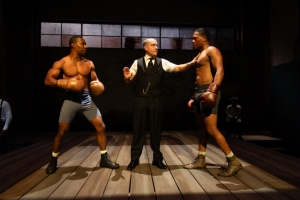
Writers Theatre scores a knockout production with Marco Ramirez’s 2013 play, The Royale. Under the direction of Tyrone Phillips, we see this widely-produced script (it played New York’s Lincoln Center a decade ago) executed to perfection. Centered on boxing legend Jack Johnson, it follows a fictionalized version of his story. In 1910 Johnson became the first Black world heavyweight champion by besting James Jeffries, the reigning heavyweight, who was white.
The show opens with a mesmerizing percussive scene. For this production, the Writers Theatre stage is floored with rough hewn boards to make a boxing arena, the building’s back wall exposed with faded painted bricks. A punching bag hangs at the back of the set and as lights come up, a lone boxer is pummeling it. (Lauren Nichols is Scenic Designer.)
Soon another boxer enters the stage and the two begin a wordless, precisely choreographed percussive dance centered on the bag, their footfalls resounding loudly, reaching a crescendo at the culmination, a scene that draws applause for its sheer inspired beauty. (Rasell Holt is Movement Director.) The audience knows it is in for something big in The Royale.
Ramirez, a well-established Netflix writer (Orange is the New Black, Daredevil) keeps the tale rooted in the true story. Our fictional heavyweight star Jay is played superbly by Broadway star La’Tevin Alexander. And man, he is good!
When Alexander takes the stage, his sculpted body is arresting and he is handsome in a Michael B. Jordan way. But as he begins to deliver his lines, he soon has us in his thrall, a larger than life force, like Muhammed Ali, supreme in his confidence and aiming at the top. Yet Jay is also warm and magnetic. We can’t help getting behind him.
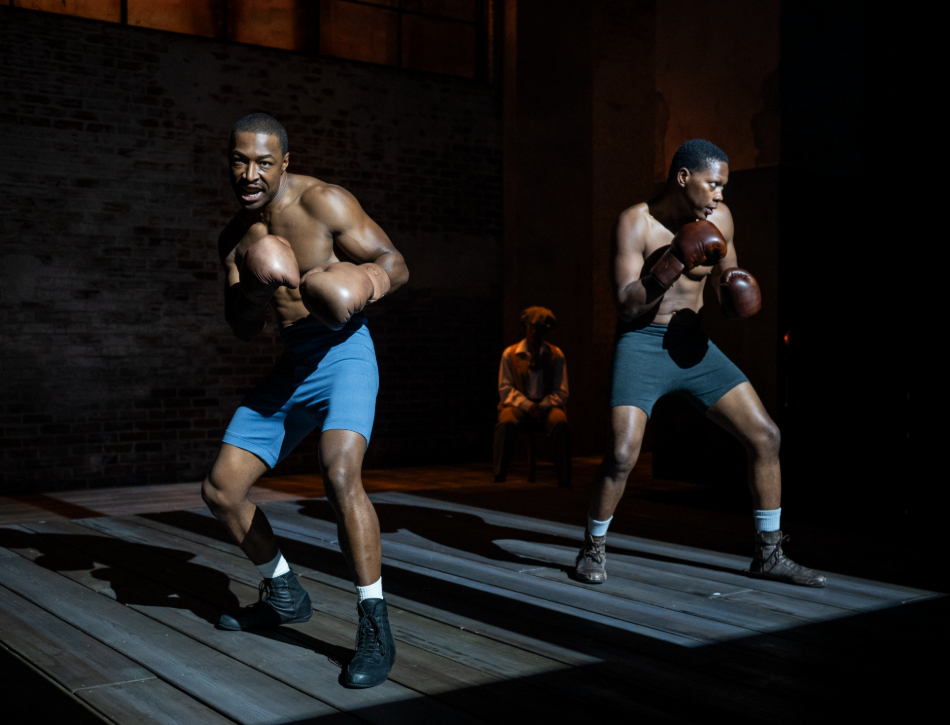
La’Tevin Alexander as Jay (left) and Ajax Dontavius as Fish, in a bout as trainer Wynton (James Vincent Meredith) looks on. Photo by Michael Brosilow.
Entering a spar with a visibly frightened first-time boxer Fish (Ajax Dontavius), Jay works the audience. “How many rounds you want me to give you?” he asks us, all calm and confident. The presentation of the match is inventive: the two stand at angles and shoulder to shoulder, then punch or receive hits toward the seated crowd, stomping their feet to sound the impacts. Particularly inspired is the lighting, which heightens the drama and delineates regions of the stage, such as the boxing ring, rectangles of light narrowing as bouts draw to a close. (Jason Lynch is Lighting Designer.)
After Round 4, Jay prances, feigning boredom perhaps. “How you all doing?” he asks us spectators, adding lightheartedly, “I heard tell there was a fight here tonight.” After he vanquishes Fish, who survives and even lands some blows that surprised his adversary, Jay hires him as his sparring partner.
After the knockout, Jay dons a suit and reveals his ambition to his promoter Max (Scott Aielio): to take on the retired white championship boxer, Bigsby. (In real life, Jack Johnson coaxed James Jeffries out of retirement to take him on.) When Black people box each other, Jay says, their boxing stories only make the inside pages of the newspapers. But if he battles a white champion, Jay will make the front page, where even non-readers will register his fame.
“Bixby’s never fought a Negro. No one ever has,” Jay says of his white counterparts.
“The paper says Bixby would disgrace his legacy by stepping into the ring with you,” Max tells him. Such was the tenor of the times of Jim Crow. Nevertheless Jay drives his reluctant manager to negotiate a fight for him with Bixby, and Max scores an offer, albeit one-sided. Bixby wants 90 percent of the ticket sales.
Another character inhabits many scenes, Jay’s trainer Wynton (James Vincent Meredith). Limping and dispensing advice judiciously, Wynton triggers the description of a racist entertainment called “battle royales” (from which the play takes its name) in which a crowded ring of blindfold Black boxers battled until only one was left standing.
Wynton also bears witness to Jay’s braggadocio, and toward the end, the aftermath of the boxer’s encounter with his sister Nina (AnJi White). She shows up like a deus ex machina to add gravity to Jay’s quest, just hours before the match. Jay is already struggling with nerves, having learned of multiple armed threats against his life, knowledge Wynton did not share with him.
As Nina and Jay explore their shared past, Nina serves to reveal Jay’s deeper motives in his quest: to right wrongs where young Black women didn’t see themselves reflected in ideals of beauty, even maiming themselves with dangerous hair straightening chemical and hot iron treatments.
Nina warns Jay of a potential consequence if he bests Bixby: Black people will be punished by whites angered in reaction to his success, should he win. In the dramatic structure, this added pressure suddenly summoned into the script so close to the end seems unnaturally crammed in, almost melodramatic in its effect. In my mind it detracted from the seriousness of the concern itself.
In fact Nina was proven right. In real life, race riots were ignited by Jack Johnson’s victory over Jeffries, documented in a huge newspaper front page unfurled at the final moment of the show.
Two scenes I relished: Fish has given away his seat, and plans to listen to the fight on a radio in a bar, which will lead to another tragic event. Dontavius gives us Fish’s ecstatic joy over the imminent fight, which he showers obliviously on a deeply distressed Jay. The other scene is Scott Aielio’s soliloquy as Max on his dedication to Jay’s career, and the challenges it has presented for him as a white man steering Jay protectively as the boxer all the while flaunts the evil restrictions of Jim Crow. Max argues compellingly not to win gratitude, but to convince Jay that he has been and is truly dedicated to him.
The Royale is highly recommended as a theatrical experience, and a worthy revelation of history less present today. It runs through November 29, 2026 at Writers Theatre in Glencoe, IL.
Neo Futurist's "Seven Fights": How to Fight Back in the Arts and Win - Without Actually Drawing Blood

I went to see "A Story Told in Seven Fights" at Neo-Futurists Theater on my birthday for two reasons. One, I wanted to have a fun, exciting interactive theater experience and two, because my dear friend and college classmate, actor, comedy writer Phil Riddarelli was one of the original members and founders of the theatre’s longest running hit, "Too Much Light Makes the Baby Go Blind.”
I am happy to say it was a very happy birthday experience indeed.
Even if you know nothing about the play's stories regarding the rift that occurred between the ensemble members and original founder Greg Allen in 2016, which prompted the company members to change its most popular production's name to "The Infinite Wrench," or the seven real life historical fights between Arthur Cravan, or his contemporaries Tristan Tzara and Andre Breton and boxing champion Jack Johnson, you will STILL totally enjoy this show! If unfamiliar, worry not. You'll catch on quick and, in the process, learn amazing stories such as the time when Cravan, a poet and philosopher in the early 20th century who ushered in the birth of Dadaism and Surrealism, actually fought the unbeatable Jack Johnson in an exposition match that he publicized to raise money for himself. This is just one of his many fights.
"Seven Fights" is the epitome of what this theatre stands for as it holds true to that from the Neo Futurist company’s website info:
"From our namesakes, the Italian Futurists, came the exultation of speed, brevity, compression, dynamism, and the explosion of preconceived notions (although not the warlike fascist tendencies). From Dada and Surrealism came the joy of randomness and the thrill of the unconscious. From the theatrical experiments of the 1960’s came audience interaction, breaking down all notions of distance, character, setting, and illusion. Finally, from the political turmoil of the 1980’s came a socially conscious voice and a low-tech, “poor theater” format. This aesthetic would eventually become the guiding principle of all work produced by The Neo-Futurists".
"Youth in revolt!" If it's a system, it needs to be smashed. The safety bubble created to protect us from the system has now become a system - so let's smash it.
Trevor Dawkins and director Tony Santiago have created a 90-minute long format play that is socially conscious, exciting to watch and full of "poor theater" energy that keeps the audience both laughing and thinking at the same time for every minute of this super funny and thought-provoking production. "Seven fights" is Oracle Production's Tony Santiago's Neo-Futurist debut and it appears he's a good fit for the progressive theatre company. Dawkins also gets a huge assist from his surrounding cast members that include Jen Ellison, Rasell Holt, Arti Ishak, TJ Medel, Kendra Miller, Stephanie Shum and Jeff Trainor. Holt is exceptional as legendary Jack Johnson (not the guitarist!) who became the first African-American World Heavyweight Champion in 1908. Ellison also stands out in a surprise role, infusing her own unique blend of humor into the production, a talent that has been enjoyed in past productions by both Neo-Futurist and Second City fans.
Cast members actually stage elaborate fights under Gaby Labotka's well-choreographed fight direction and do other interesting things like drawing a chalk line on the stage where they talk to each in "real life" on one side of the line and "in character" on the other side of the line. Throughout the play audience is swept along to consider their own inner battles with how to properly and safely express anger over whatever may be "seven fights' in their own lives, perhaps like the ones many of us feel we are experiencing under Trump's reign of terror in our country right now.
In most of our lives actual fighting is not the answer for normal, yet persecuted, people to pursue without making the situation worse.
Dawkin's very interesting script, which reminds me of a famous ensemble piece about the Kennedy assassination called "The Serpent" back in the 60's, gives the audience many entertaining and thoughtful ways to channel their anger and even turn it into humor and art.
I highly recommend this super funny, energy-packed show to people of all ages who want to have a lively and positive theater experience that they will not forget.
"A Story Told in Seven Fights" is currently being performed at the Neo-Futurists Theatre through April 7th. For more show info visit www.neofuturists.org.



Latest Articles
-
 Steppenwolf's Adirondack Chair Circle: The Joke Lands. Then What?
Written by Maddie BurroughsI went into Adirondack Chair Circle wondering what a new play about book bans could add to a conversation whose arguments most of its audience could probably already recite. A world premiere at Steppenwolf seemed worth giving the benefit of…
-
 Nov. 23 at the MAC: "An Evening with Gary Sinise" Author of "Graceful Warrior" to Benefit WSFDV
Written by Buzz Center StageWest Suburban Foundation for Disabled Veterans (WSFDV) presents "An Evening with Gary Sinise," Author of "Graceful Warrior" at the McAninch Arts Center (MAC) located on the campus of College of DuPage, 425 Fawell Blvd. Monday, Nov. 23 at 6:30 p.m. Sinise, an…
-
 Remarkable Production Makes 'The Royale" a Knockout Show
Written by Bill EslerWriters Theatre scores a knockout production with Marco Ramirez’s 2013 play, The Royale. Under the direction of Tyrone Phillips, we see this widely-produced script (it played New York’s Lincoln Center a decade ago) executed to perfection. Centered on boxing legend…
-
David Salsbery Fry returns to Chicago Opera Theater for fourth production with company in Chicago Premiere The Importance of Being Earnest - December 2-6
Written by Buzz Center StageDavid Salsbery Fry sings the role of Rev. Canon Chasuble in the Chicago Premiere of Chicago Opera Theater’s (COT) production of Castelnuovo-Tedesco’s humorous and final stage work – a “sparkling operatic adaptation of Oscar Wilde’s beloved play and a joyful tribute to…
Does your theatre company want to connect with Buzz Center Stage or would you like to reach out and say "hello"? Message us through facebook or shoot us an email at This email address is being protected from spambots. You need JavaScript enabled to view it..
*This disclaimer informs readers that the views, thoughts, and opinions expressed in the text belong solely to the author, and not necessarily to Buzz Center Stage. Buzz Center Stage is a non-profit, volunteer-based platform that enables, and encourages, staff members to post their own honest thoughts on a particular production.